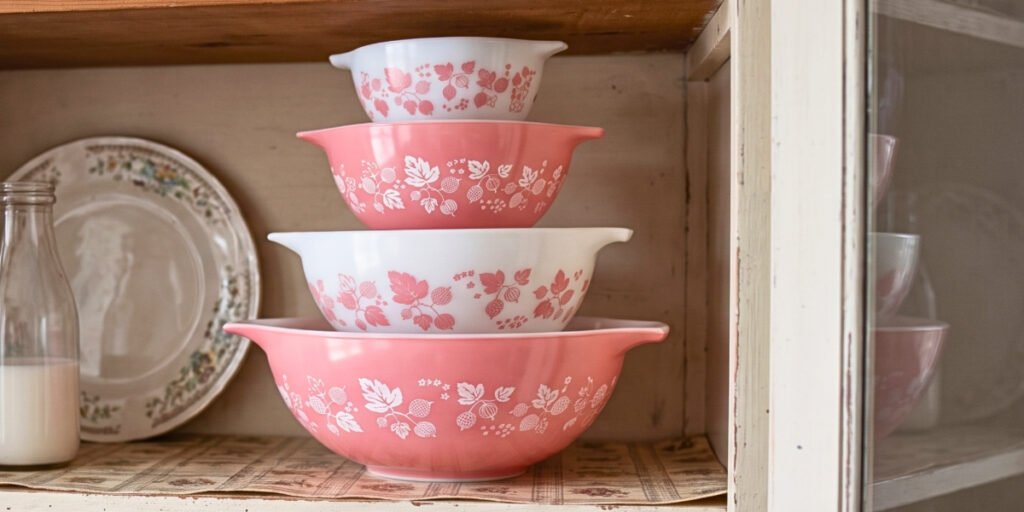
You have a milk-white bowl with either a pink or turquoise pattern in front of you that you just turned over. Whether it came from an estate sale or your mom’s kitchen cupboard, you would like to know more about it.
This is where this vintage Pyrex value guide will help you. In the end, you will learn to spot a vintage Pyrex, understand its markings, identify the pattern, and place the piece on an accurate value scale.
- What it is: Corning’s heat-resistant glass kitchenware, especially the colored opal (milk glass) line.
- Made: Launched in 1915. Colored opal bowls arrived in 1945; printed patterns in 1956.
- Worth: Most pieces sell for $5 to $40. Scarce sets bring $200 to $1,000, and the rarest has sold for nearly $6,000.
- Fastest way to spot: An all-caps PYREX mark with a model number on the back.
Before You Begin
You don’t need any special tools. Natural sunlight or a white LED will do most of the work. If you need to look at backstamps that are very faint, a magnifying glass or your phone’s zoom function would be enough.
How to Tell If Pyrex Is Vintage: 5 Checks
Identification is best done in order. Each Step narrows things down, and by the fifth one you’ll usually know the maker, the rough age, and the pattern.
Check 1: Marks, Stamps and Labels
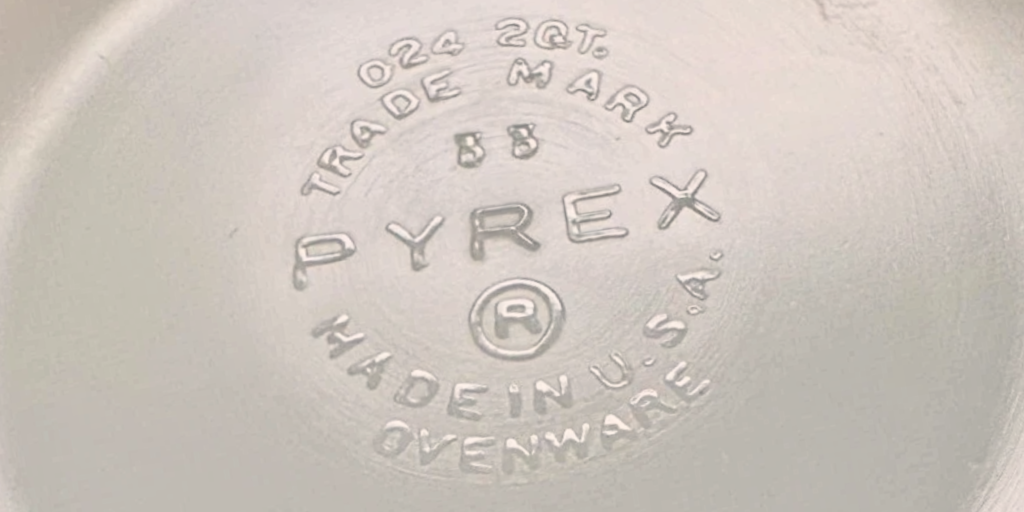
Look out for the Pyrex logo on the bottom of the piece. Notice whether the PYREX logo is capitalized, and look for a company name along with the country, such as “Corning Glass Works,” “JAJ,” or “Made in U.S.A.”
Pieces made by the older Corning Corporation have the all-caps PYREX logo, sometimes with a model number included. A lowercase Pyrex logo began appearing in 1994 when Corning still had control of the brand.
“Made in France” Pyrex logo indicates Arc International’s modern borosilicate glass products.
Vintage Pyrex Mark Decoder
Here’s the table worth saving, so bookmark it now. Use it alongside Check 1 to date your backstamp, and make sure the pattern and model number agree with the mark.
| Mark | What it looks like | Years used | Notes |
| Early Corning mark | PYREX, “Corning Glass Works,” patent dates | 1915 to 1940s | Mostly clear bakeware |
| All-caps PYREX with number | PYREX, “Made in U.S.A.,” number and capacity | 1945 to 1980s | Main collectible opal era |
| “Corning Inc.” wording | All-caps PYREX with Corning Inc. | 1989 to 1998 | Company renamed in 1989 |
| Lowercase pyrex | “pyrex” in small letters | About 1994 onward | Not vintage |
| JAJ PYREX | “JAJ PYREX,” “Made in England” | 1922 to mid-1970s | British licensee, own patterns |
| AGEE PYREX | “AGEE PYREX” or “CROWN AGEE PYREX” | 1926 to about 1970 | Made in Australia |
Check 2: Model Number and Shape
Model numbers make identification more precise. Corning placed a number and capacity on the majority of the opalware pieces, and the number will identify which dish/set you have.
- 401 to 404: Round nesting mixing bowls (1945)
- 441 to 444: Cinderella bowls with handles and spouts (1957)
- 471 to 475: Round casseroles (1958)
- 501 to 503: Refrigerator dishes, aka “fridgies” (1947)
Check 3: Glass Type
Next, check out the body. Does it have color applied to a white glass body, or is it clear? White opal glass (what Corning calls milk glass) is worth the most money, whereas clear bakeware doesn’t fetch much cash.
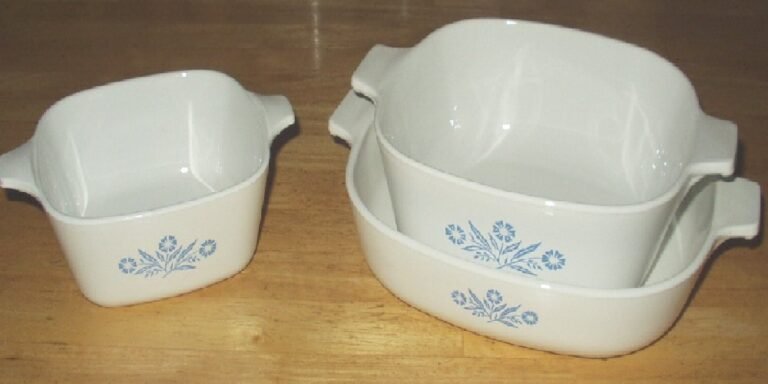
Beware of Look-Alikes! Fire-King, Glasbake, and Hazel-Atlas produced their own milk glass bowls. Also, CorningWare is not Pyrex; it is a white glass-ceramic material that has the properties of stoneware.
Check 4: Pattern & Color
Identifying the pattern can also help you identify the era.
For example, the first colored Opalware patterns, introduced in 1956, were Pink Daisy and Snowflake (Blue). Butterprint was manufactured from 1957-1968; Gooseberry was made from 1957-1966; Butterfly Gold was made from 1972-1981.
You can check the pattern details in catalogs or online resources to know its name and manufacturing years.
Also, always run your fingers over the pattern. Factory patterns are fired on the glass and therefore will have a smooth surface without lifting edges.
Look-Alike Warning: Vinyl or hand-painted “custom” Pyrex is quite common. A brush stroke on the pattern or a lifted edge means that it was not decorated at Corning.
Check #5: Lid & Label
All casseroles and fridgies came with lids, and those lids also have their own numbers. Having a matching lid increases the value, and having a paper label from Corning adds to that value.
Real vs. Reproduction
Outright fakes are rare with Pyrex. The real problems are newer pieces sold as old, painted “customs,” and damaged glass dressed up to look fresh. Here’s how old Pyrex vs. new Pyrex compares.
| Feature | Genuine Vintage Pyrex | Reproduction or Later |
| Logo | All-caps PYREX | Lowercase pyrex or no mark |
| Pattern | Fired-on, smooth | Decal, vinyl, or peeling paint |
| Body | Solid white opal glass | Clear glass painted outside |
| Base wear | Light ring of wear on the foot | Spotless base on a “1950s” piece |
Value of Vintage Pyrex: How Much Is Yours Worth?
So you’ve identified your vintage Pyrex piece, but how much is it worth? Even two identical white bowls from the same thrift store shelf might fetch prices of $8 and $800.
The reason for this price difference always comes down to five factors: pattern, color, completeness, shape, and condition.
Rare Patterns
Nothing is more important than pattern. Normal patterns such as Butterprint have been in high production for many years, so plenty are available.
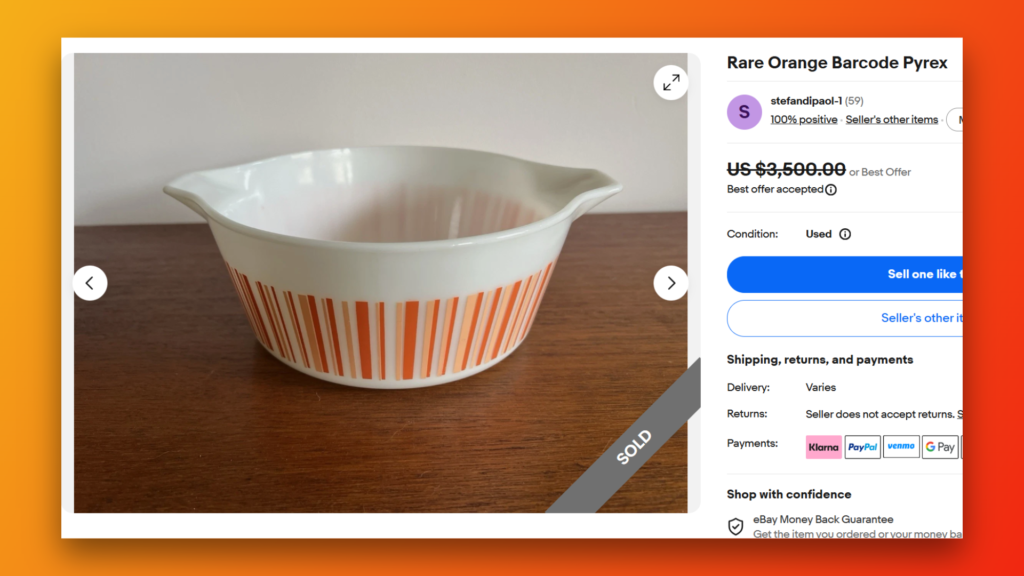
But things were different for promotional patterns since Corning produced them in limited quantities or to be used only during one season. It’s the short shelf life that makes these pieces very special and expensive.
For instance, a Pyrex Butterprint bowl costs $25 to $75, but a Starburst casserole promotional piece can fetch up to $400.
Pattern Color
Color impacts the value in two ways. Firstly, some color combinations have greater popularity, so it isn’t surprising that pink tops every wish list. Secondly, color should be vivid; a shiny and brilliant look will beat faded versions in any number of washings.
Completeness (Accessories, Lids & Boxes)
Bowl sets were made as a set of four that would nest into one another, and most sets were broken apart with time. So, finding all four bowl sets with the same color and design is not an easy feat, and collectors tend to pay extra for it.
The casseroles were packaged with glass lids, and the promotional sets included metal carriers or trays. The additional items wore out or got lost quickly. So, any casserole with its original lid and tray will be more valuable than one without the extra accessories.
An original Corning box or label indicates that the piece is authentic and was used very little. This explains why the boxed sets are more valuable than the unboxed sets. Never discard an original box even if it is worn.
Uncommon Shapes
Round mixing bowls are the most common pieces, so everyone sees them. But shapes like Cinderella bowls with a pouring spout, fridgie sets, and oval casseroles are rarer. A similar pattern on an uncommon shape tends to sell for more money.
Condition
Condition decides where a piece lands on the pricing scale. Collectors want a glossy surface, a crisp print with no thin spots, and a clean rim with no chips. So hold the piece under bright light and check each of those before you name a price.
Based on these factors, here’s what boosts the value:
- A scarce or short-run promotional pattern
- Glossy color with no fading, no chips or cracks
- A complete nesting set with all four sizes
- The original matching lid
- The original box or Corning paper label
- An uncommon shape, like a fridgie set
Factors That Reduce the Price
Condition affects the value of Pyrex more than most realize, especially the wear from dishwashing. The following is an approximation, which is based on the condition of the items compared to their counterparts without any damage.
- Damage by dishwashing (dull finish, chalky or faded design): reduces value by 50% to 80%
- Chipped rims and/or bases: reduces value 40% to 70%
- Cracks: reduces value 80% to 100%
- Missing casserole lid: reduces value by 30% to 50%
- Utensil gray marks: reduces value by 10% to 30%
- Scratches or worn design: drops value by 20% to 40%
Tip: Dishwasher-damaged items may be coated with oil to look shiny. Wash suspicious bowls first if they feel oily before spending collector dollars.
Most old Pyrex pieces are inexpensive, but there are valuable Pyrex items, too. Turn the piece around, decode the mark, identify the pattern, and assess the condition. Those simple things will answer most questions about an antique Pyrex piece.