

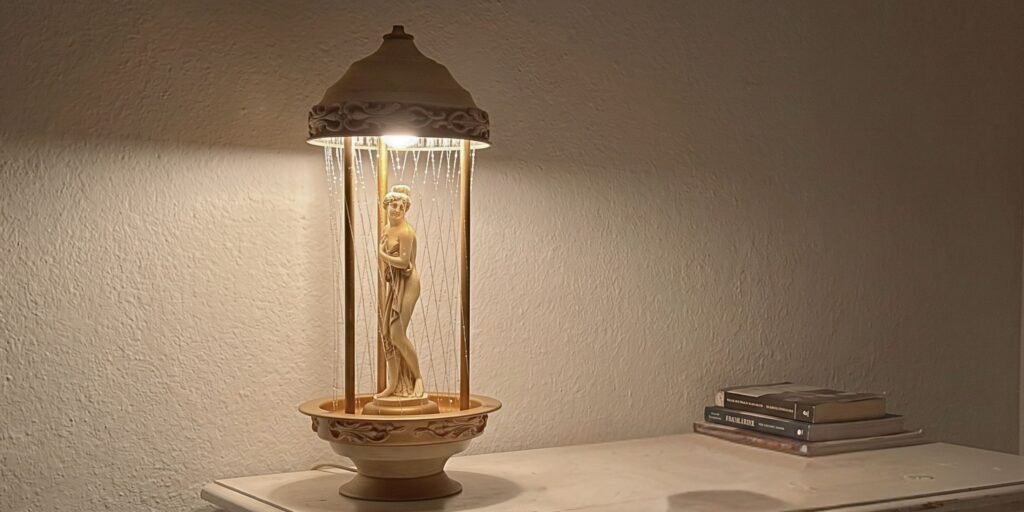
Rain lamps were never really meant to be treasures. They were made simply as a fun living-room décor element, with mineral oil sliding down fine strings around a goddess or a little water wheel. Lots of families had one hanging.
But today, collectors excitedly pay hundreds of dollars for these lamps.
Many rain lamps still turn up at estate sales and thrift stores for the price of a common lamp. So, it’s worth knowing what separates a common model from a rare rain lamp.
- Peak Years: 1960s and 1970s
- Key makers: Johnson Industries and Creators Inc. of Chicago
- Typical value: About $150 to $800 for working lamps
How Does a Vintage Rain Lamp Work?
A rain lamp basically has a pump located at the bottom. The pump pumps the mineral oil to the top and lets it flow slowly along dozens of strings.
And since oil is thicker than water, it forms little beads that crawl down each string instead of pouring straight down. That’s what creates the gentle “rain” effect. Most lamps also have a central figure, some artificial ferns, and a light bulb.
Decorative oil lamps came back in the 1960s, and rain lamps were popular in the early 1970s. The original design was made by Johnson Industries, featuring the goddess Venus. Creators Inc. of Chicago soon joined with its own versions.
Did You Know? The oil in a rain lamp matters more than most people think. The best option is a heavy grade called Drakeol 35. Thin oil just runs down the strings and doesn’t form those slow, pretty droplets.
How Much Is a Vintage Rain Lamp Worth?
A vintage rain lamp can be worth $150 to $700, depending on the maker, design, and condition. Small tabletop and novelty pieces, like 16-inch dolphin, elephant, and palm tree, religious figures, usually go for $90 to $260.
Hanging Venus or goddess oil rain lamps can sell for $145 to $800, while Grist Mill, Three Goddesses, and named figure examples are worth the most.
5 Things That Determine a Rain Lamp’s Value
1. Working Condition
Condition is most crucial for value. An evenly pumping, lighting, and raining lamp is much more valuable than a parts lamp. Some “working” lamps will only light up or rain unevenly, so always ask for proof (like a video) before paying anything.
2. Manufacturer and Design
Johnson Industries and Creators Inc. are the most trusted manufacturers among collectors. Unbranded lamps can be valuable if the design is popular. Also, rare designs, such as the Grist Mill, fetch more than common Venus ones.
3. Lamp Size
Tall hanging rain lamps that measure 30 to 36 inches usually fetch more than small 16-inch table lamps. But large lamps also cost between $45 and $70, or even more for shipping, which should be considered while trading.
4. Completeness
Original intact strings, original leaves, the lampshade, and the manufacturer’s label all increase the value. Each missing part gives a buyer an excuse to drop the price. Lamps with replacement or heavily repaired parts are also worth less.
5. Restoration
Restoration is a subjective factor. Some collectors want serviced or restored lamps with fresh oil and new strings. A replaced pump is widely accepted, but LED conversions are something not every buyer prefers.
6. Wear and Packaging
Light rubbing or paint cracks usually don’t hurt the value much, but deep-settled rust, dents, and broken trim do. On the other end, a lamp still unused in its original box is a jackpot.
8 Most Valuable Vintage Rain Lamps & Their Values
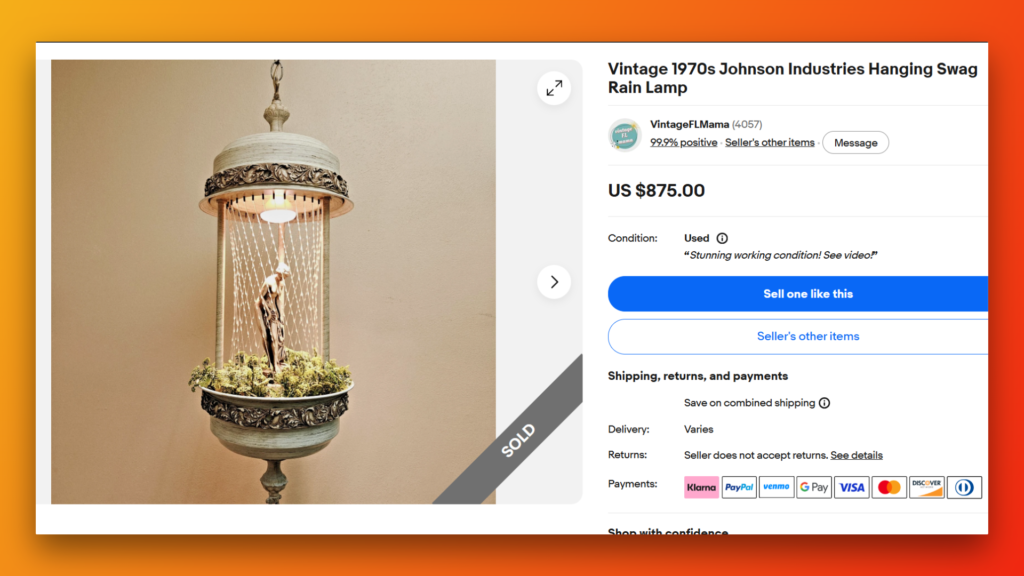
- Johnson Industries Venus Goddess Lamp: This is the design that started the trend of rain lamps. The hanging rain oil lamp version is especially popular with mid-century collectors. Clean, working examples regularly sell in the $380 to $400 range. This pristine example sold for $875 on eBay.
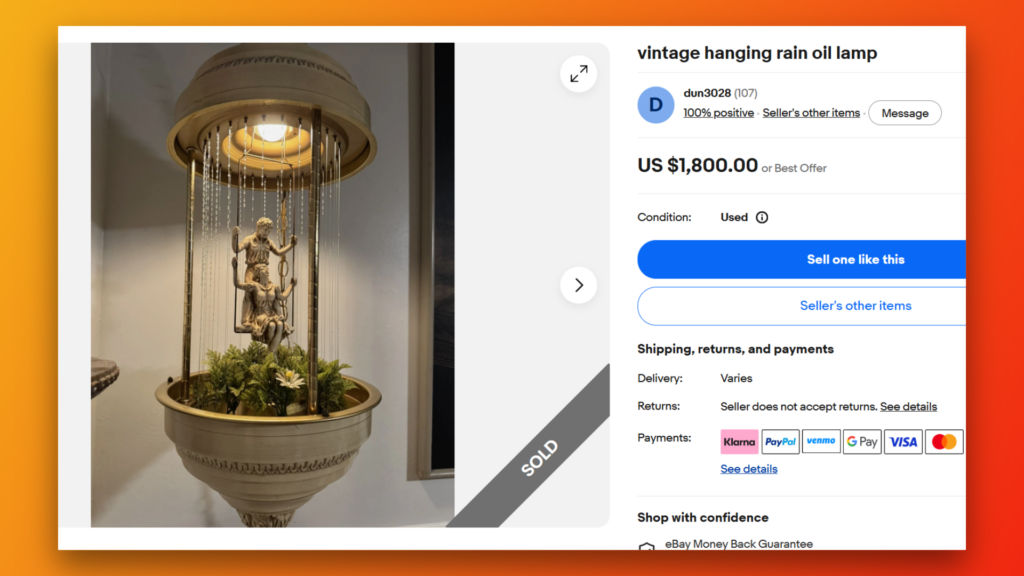
- Creators Inc. Couple on a Swing Lamp: Instead of a goddess, this lamp shows a young couple on a swing, with the boy standing behind the seated girl. Romantic scenes like this are rarer, and one was recently listed on eBay for $1,800.
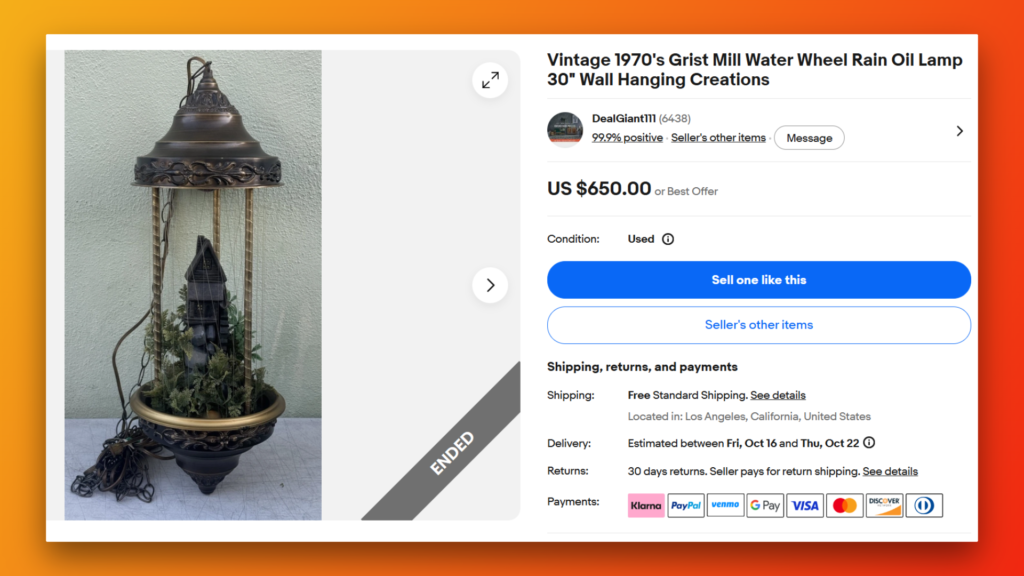
- Creators Inc. Grist Mill (Water Wheel): The most desirable feature of this lamp is a moving part (which only a few had); a little mill wheel turns as the oil falls. The largest lamps in the series often bring $450 to $600 or more.
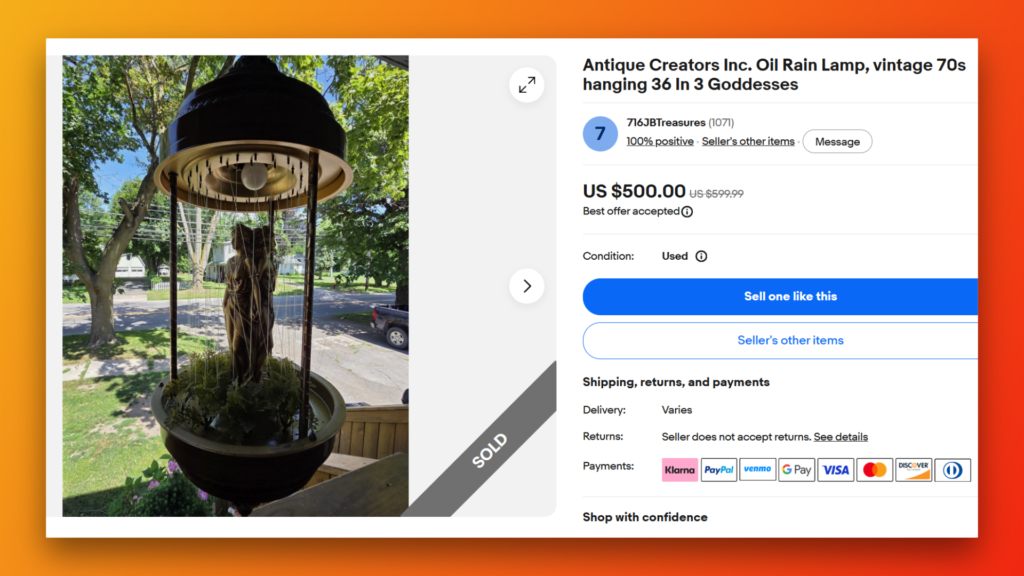
- Creators “Three Goddesses” Lamp: Also called the Three Graces. This model features three figures instead of one. It’s larger and more detailed than the standard goddess lamp. A large 36-inch hanging Three Graces model sold recently for $500.
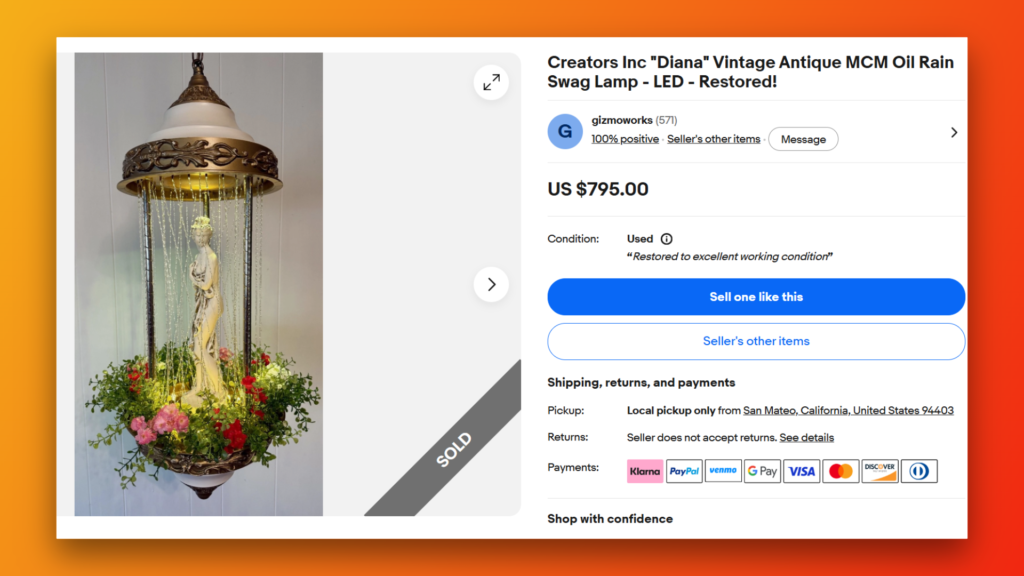
- “Diana” and Other Named Figures: Lamps featuring named figures have slightly more collector demand. “Diana,” “Don Juan,” and “lady-in-the-rain” designs are some of the most popular names. These are harder to find than the usual Venus, which drives the price.
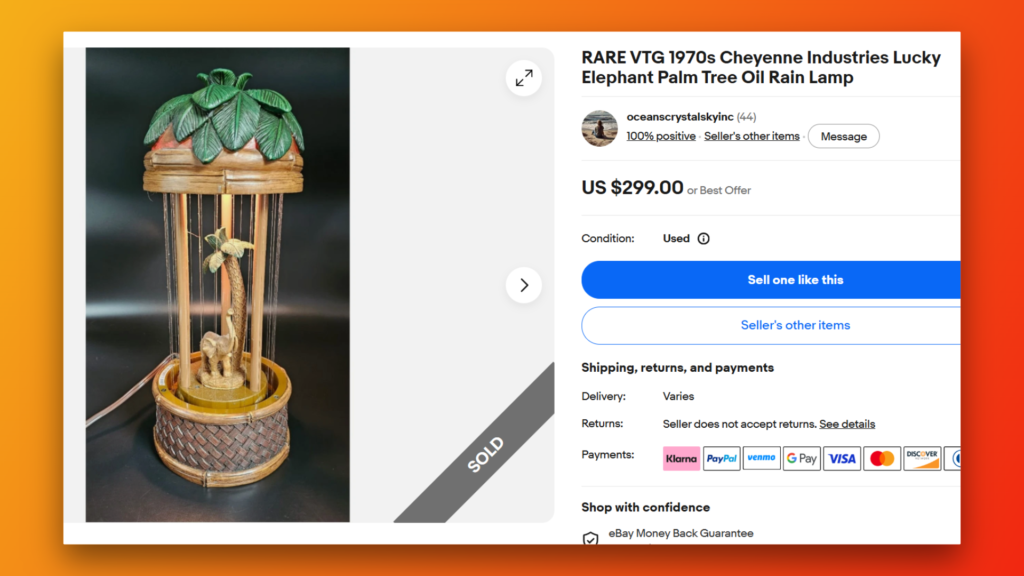
- Elephant and Palm Tree Lamp: These are smaller 16-inch tabletop lamps with an elephant standing under a palm tree at the center. A perfect 1970s charm. Clean and working examples regularly sell for $90 to $350 today.
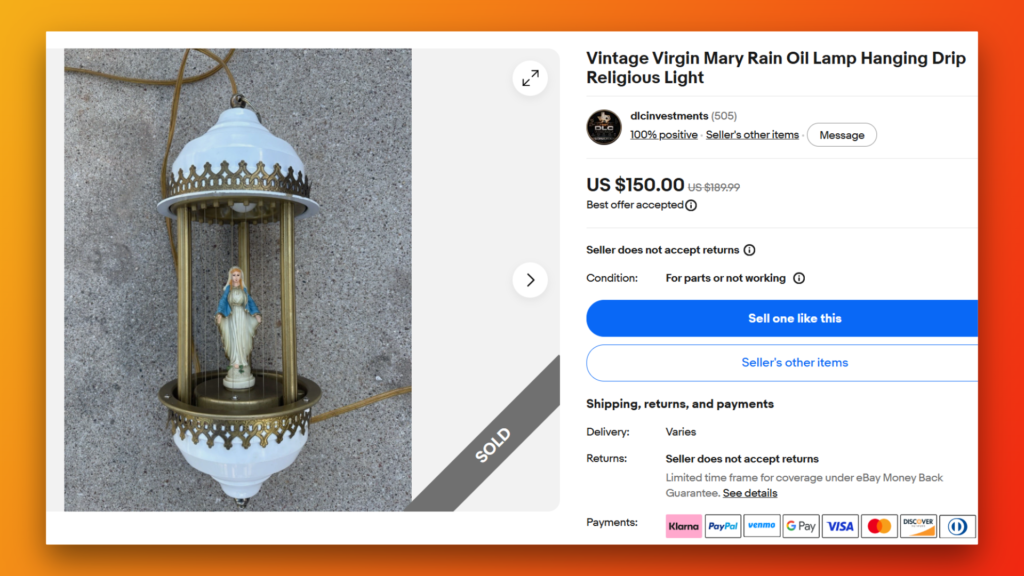
- Religious Figure Lamps: Both tabletop and hanging rain lamps came with the Virgin Mary or Jesus at the center. These are smaller and quieter in style, but still collectible, and good ones don’t surface often. One Virgin Mary drip lamp recently sold for $150.
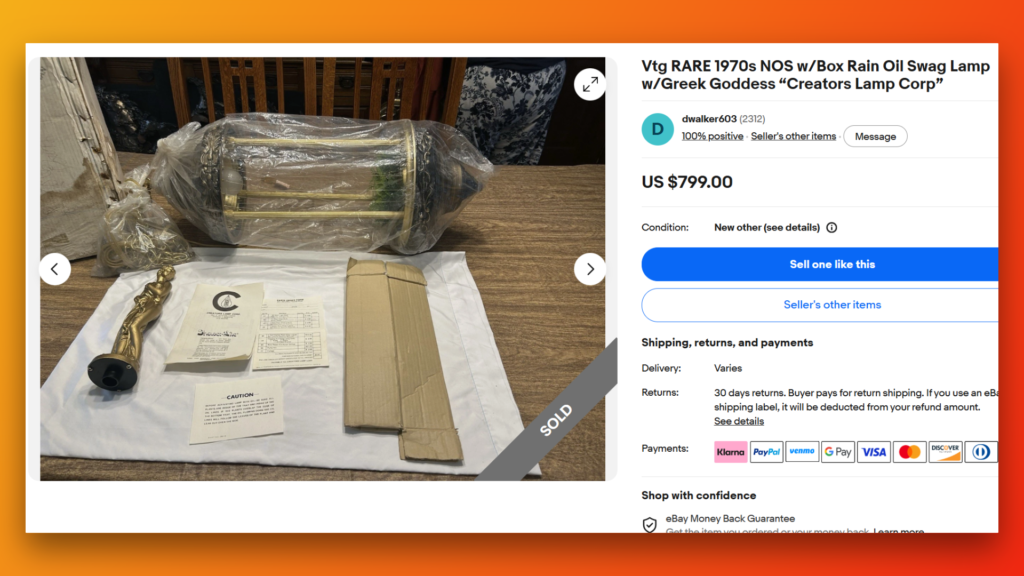
- New-Old-Stock Lamps: Every so often, a lamp turns up that was never used and still sits in its original box. These are true finds. A 1970s Creators Lamp Corp. Greek Goddess lamp in that condition sold for around $800.
How to Identify a Vintage Rain Lamp in 5 Checks
To correctly identify a vintage oil rain lamp, all you need is your hands, your eyes, good lighting, and some knowledge of what to check.
- Feel the Weight: Pick the lamp up first and feel its weight. Genuine Johnson lamps were built from heavy brass or chrome, so they feel solid and substantial. In contrast, modern copies have a light metal or plastic cage. Also, old metal frames often show light wear.
- Maker’s Attribution: Look for a maker’s sticker or tag on the base, the top cap, and the underside of the oil tray. An original sticker with a serial number is the best proof of age and authenticity. But no label doesn’t mean forgery. Stickers fall off over the decades, and some original Johnson tabletop lamps were never even marked.
- Pump and Motor’s Condition: An older pump usually looks bulky and mechanical. A newer one often looks small and sleek. Also, note that many vintage rain lamps got replacement pumps over the years. That’s common, and it doesn’t ruin a lamp. But it should be made clear beforehand.
- Design Details: You will see the real on small parts. For instance, a large Creator’s Grist Mill lamp has a metal bottom tray, but later models had plastic ones. The figure also shows fine paint crackling with age. Original faux ferns and a simple toggle switch are good signs, too.
Most original rain lamps from Creators and Johnson are documented. So, before you buy or sell one, make sure to compare the shape and figure with known examples to be double sure of authenticity.
A vintage rain lamp can be a lot more than old décor. While many sit unnoticed on thrift store shelves, you can spot the rare ones using simple tips and quick checks.